
17 min read
Two-way radio communications failure, or lost communications, is the loss of the ability to communicate by radio (Pilot/Controller Glossary). Under instrument flight rules (IFR), 14 CFR 91.185 says what to do next, unless air traffic control (ATC) has authorized something else.
After a failure, ATC provides service on the basis that you're following 91.185 (Aeronautical Information Manual, AIM 6-4-1c), so the route, altitude and times you fly are the ones a controller expects to see.
Lost communications at a glance (14 CFR 91.185; AIM 6-4-1 to 6-4-3)
- In VFR (visual flight rules) conditions, or if you reach them after the failure: continue under VFR and land as soon as practicable.
- In IFR conditions, the route, first that applies:
- the route in your last clearance;
- if vectored, direct from where the radio failed to the fix, route or airway in the vector clearance;
- the route ATC told you to expect;
- the route you filed.
- The altitude: the highest of the last assigned altitude, the minimum IFR altitude and the altitude ATC told you to expect, for each route segment.
- Leaving the clearance limit:
- At a fix where an approach begins, start the descent, or the descent and approach, as close as possible to the EFC (expect further clearance) time. Without an EFC, start as close as possible to your ETA (estimated time of arrival).
- At any other fix, leave at the EFC time. Without one, leave when you arrive. Then fly to a fix where an approach begins and start the descent or approach as close as possible to your ETA.
- Transponder: code 7600 (AIM 6-4-2).
In VFR conditions: stay VFR and land as soon as practicable
If the failure happens in VFR conditions, or you reach VFR conditions after it, continue the flight under VFR and land as soon as practicable (14 CFR 91.185(b)). The IFR rules in 91.185(c), for the route, the altitude and leaving the clearance limit, apply when the failure occurs in IFR conditions, or when you can't comply with (b).
VFR conditions means weather at or better than the minimum for flight under VFR (Pilot/Controller Glossary). Those are the visibility, cloud clearance and, in an airport's surface area, ceiling minimums of 14 CFR 91.155.
"As soon as practicable" doesn't mean "as soon as possible." You don't have to land at an unauthorized airport, at one unsuitable for your aircraft, or only minutes short of your destination (AIM 6-4-1c2, note).
The VFR paragraph also applies to a failure in Class A airspace. Its purpose is to keep an aircraft without a radio from extended IFR operation in the system, where ATC may have to reroute or delay other traffic to protect it (AIM 6-4-1c2, note).
For a situation 91.185 doesn't cover, the AIM expects you to use good judgment and, if the situation dictates, not to be reluctant to use your emergency authority (AIM 6-4-1a). Whether a radio failure is an emergency depends on the circumstances, and it's your determination as pilot in command. In an in-flight emergency requiring immediate action, 14 CFR 91.3(b) lets you deviate from any rule of Part 91 to the extent required to meet it.
Which route to fly
In IFR conditions, fly the first route on this list that applies (14 CFR 91.185(c)(1)):
- The route assigned in the last ATC clearance you received.
- If you're being radar vectored, the direct route from the point of radio failure to the fix, route or airway specified in the vector clearance.
- If no route is assigned, the route ATC has advised you may expect in a further clearance.
- If there's neither, the route you filed.
A vector is a heading issued for navigational guidance by radar (Pilot/Controller Glossary). After a failure, leave the vector and go direct from where the radio failed to the fix, route or airway specified in the vector clearance, such as the airway in "vector to Victor two thirty-five" (the controllers' form is "vector to (fix or airway)", JO 7110.65 5-6-2).
Some procedures carry their own instructions. Radar departure procedures often include a lost communications procedure on the chart, and if you lose the radio while being vectored on one, you're expected to follow the chart, not necessarily the AIM (Instrument Procedures Handbook, IPH, chapter 1). On a radar approach, the controller issues lost communications procedures when weather reports indicate you'll likely be in IFR conditions on the approach (Pilot/Controller Glossary).
The clearance limit is the fix, point or location you're cleared to (Pilot/Controller Glossary). A clearance issued before departure normally takes you to the airport of intended landing, but it can be a navigation aid or another fix (AIM 4-4-3a).
Which altitude: the highest of three, segment by segment
Fly the highest of these three, for the route segment you're flying (14 CFR 91.185(c)(2)):
- the altitude or flight level in your last ATC clearance;
- the minimum altitude for IFR operations;
- the altitude or flight level ATC has advised you may expect in a further clearance.
Pick the altitude for the segment you're on and adjust it for each later segment (AIM 6-4-1c3(b), note). Begin the climb to a higher minimum IFR altitude immediately after you pass the point where it begins. Where obstructions intervene, cross that point at or above the minimum crossing altitude (MCA) (14 CFR 91.177(b)).
Minimum IFR altitudes
The minimum IFR altitude on an airway is normally the minimum en route altitude (MEA), the lowest altitude between radio fixes that ensures navigation signal coverage and meets obstacle clearance requirements (Pilot/Controller Glossary). Where a minimum obstruction clearance altitude (MOCA) is also published, you may fly down to it, provided the navigation signals are available, and with very high frequency (VHF) omnidirectional range (VOR) navigation only within 22 nautical miles of the VOR (14 CFR 91.177(a)(1)). Where Parts 95 and 97 prescribe no minimum, it's 2,000 feet above the highest obstacle within 4 nautical miles of your course in designated mountainous areas, 1,000 feet elsewhere (91.177(a)(2)).
An off-route obstruction clearance altitude (OROCA) is published for situational awareness, flight planning and contingency use, and isn't assessed for navigation signal coverage, surveillance or communications (Pilot/Controller Glossary). It isn't one of these minimums.
The expected altitude applies from its time or fix
An expected altitude comes with a time or a fix ("Expect one five thousand at San Jose", in the air traffic control handbook, Order JO 7110.65, 4-3-2). After a failure (AIM 6-4-1c3(b), note):
- A higher expected altitude: until the time or fix, fly the higher of your last assigned altitude and the minimum IFR altitude. At the time or fix, climb to the expected altitude.
- A failure after that time or fix: the expected altitude no longer applies.
- A lower expected altitude: keep the higher of the last assigned and the minimum IFR altitude until the time you leave the clearance limit.
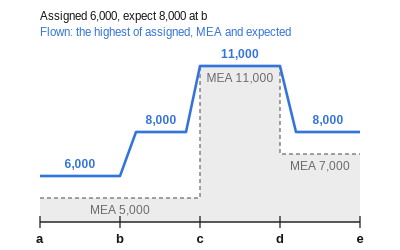
After the failure, the pilot in the AIM's example holds the assigned 6,000 feet to b, climbs to the expected 8,000, climbs to the 11,000-foot MEA at c (or before c, for an MCA), and at d descend to 8,000, not to the 7,000-foot MEA, because 8,000 is now the highest of the three (AIM 6-4-1c3(b), example 3).
If you enter a terminal arrival area (TAA) after a radio failure, keep this altitude until you reach the appropriate IAF (IPH, chapter 4).
When to leave the clearance limit and begin the approach
The rule depends on whether your clearance limit is a fix from which an approach begins (14 CFR 91.185(c)(3)). On an approach chart, those are the initial approach fixes (IAFs), which identify the beginning of the initial approach segments (Pilot/Controller Glossary).
| Clearance limit | With an EFC | Without an EFC |
|---|---|---|
| A fix where an approach begins | Start the descent, or the descent and approach, as close as possible to the EFC time | Start as close as possible to your ETA |
| Any other fix | Leave at the EFC time, fly to a fix where an approach begins, and start as close as possible to your ETA | Leave when you arrive over it, fly to a fix where an approach begins, and start as close as possible to your ETA |
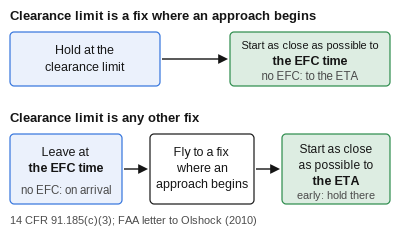
The EFC is the time you can expect a clearance beyond your clearance limit (Pilot/Controller Glossary). ATC issues one with holding instructions whenever it clears you to a fix other than the destination airport and expects a delay (AIM 5-3-8a).
Any additional delay it mentions ("anticipate additional three zero minute delay at SWEET") isn't used for a radio failure. Controllers expect you to act on 91.185 alone (JO 7110.65 4-6-1, note).
The estimated time en route is the flying time from lift-off to touchdown (Pilot/Controller Glossary). Your ETA is calculated from the one you filed, or one amended with ATC (91.185(c)(3)).
For the hold itself, see holding with a radio communications failure in the holding lesson.
When the clearance limit is the destination airport
With the destination airport as the clearance limit, 91.185(c)(3)(ii) applies, because the airport isn't a fix where an approach begins. You normally have no EFC, since ATC issues one when it clears you to a fix other than the destination airport and expects a delay (AIM 5-3-8a). Proceed to the airport, then to a fix where an approach begins, and start the descent or approach as close as possible to your ETA.
If you arrive early, the Federal Aviation Administration's (FAA) Office of the Chief Counsel says you hold at the approach fix until it's time to start the approach as close as possible to the ETA (letter to Olshock, 2010). In 2018 it was asked to reconsider and reaffirmed that reading. An operating transponder isn't a substitute for two-way communication, or for the ETA in your flight plan, which ATC relies on (letter to Van West, 2018). Your emergency authority under 91.3(b) still applies.
If the approach fix has no charted hold, the AIM's procedure for reaching a fix without holding instructions is a standard pattern on the course on which you approached it (AIM 5-3-8c). The AIM writes it for frequency congestion or a stuck microphone. It's the only procedure the AIM gives for reaching a fix without holding instructions.
Squawk 7600 and try to reconnect
These steps come from the AIM. 14 CFR 91.185 doesn't include them.
- Transponder: set code 7600, understanding that you may not be in an area of radar coverage (AIM 6-4-2).
- Listening: monitor the voice feature of the navigation aids (AIM 6-4-3a).
- Reconnecting: try the previously assigned frequency, a flight service station (FSS), New York or San Francisco Radio, or 121.5 MHz. The AIM doesn't rank them and says to try them all at once if you can (AIM 6-4-3).
- Reporting: once you reach an FSS or New York or San Francisco Radio, say that you've lost communications on the assigned frequency, give your position, altitude and last assigned frequency, and request a further clearance from the controlling facility (AIM 6-4-3b).
What ATC does after a radio failure
Under JO 7110.65 10-4-4, they take these actions as appropriate:
- use all appropriate means to reestablish contact, including emergency frequencies, the voice feature of the navigation aids, an FSS, and New York or San Francisco Radio;
- broadcast clearances through any available means;
- ask you to press the transponder's IDENT button, change to code 7600, switch to standby, or make turns, so they can see that you're receiving them;
- broadcast a clearance to your filed alternate at the MEA, if the operator concurs;
- after 5 minutes without contact, treat the flight as suspicious and report it to their supervisor.
FAA and ICAO. Under the International Civil Aviation Organization's (ICAO) Annex 2 and its air traffic management procedures (PANS-ATM), a pilot who loses communications keeps the last assigned speed and level, or the minimum flight altitude, for a set time, which 14 CFR 91.185 doesn't have. PANS-ATM uses 7 minutes where ATC has radar and 20 minutes where it doesn't. U.S. controllers start overdue-aircraft procedures when they have had neither communication nor radar contact for 30 minutes, or sooner if appropriate (U.S. Aeronautical Information Publication, AIP, GEN 1.7).
Worked examples at Cedar City, Utah
The examples use real charts in southwest Utah: the L-9 low altitude en route chart and the Cedar City (CDC) approach charts. The times and clearances are invented. The aircraft climbs at 500 feet per minute and has a ground speed of 120 knots (2 nautical miles a minute).
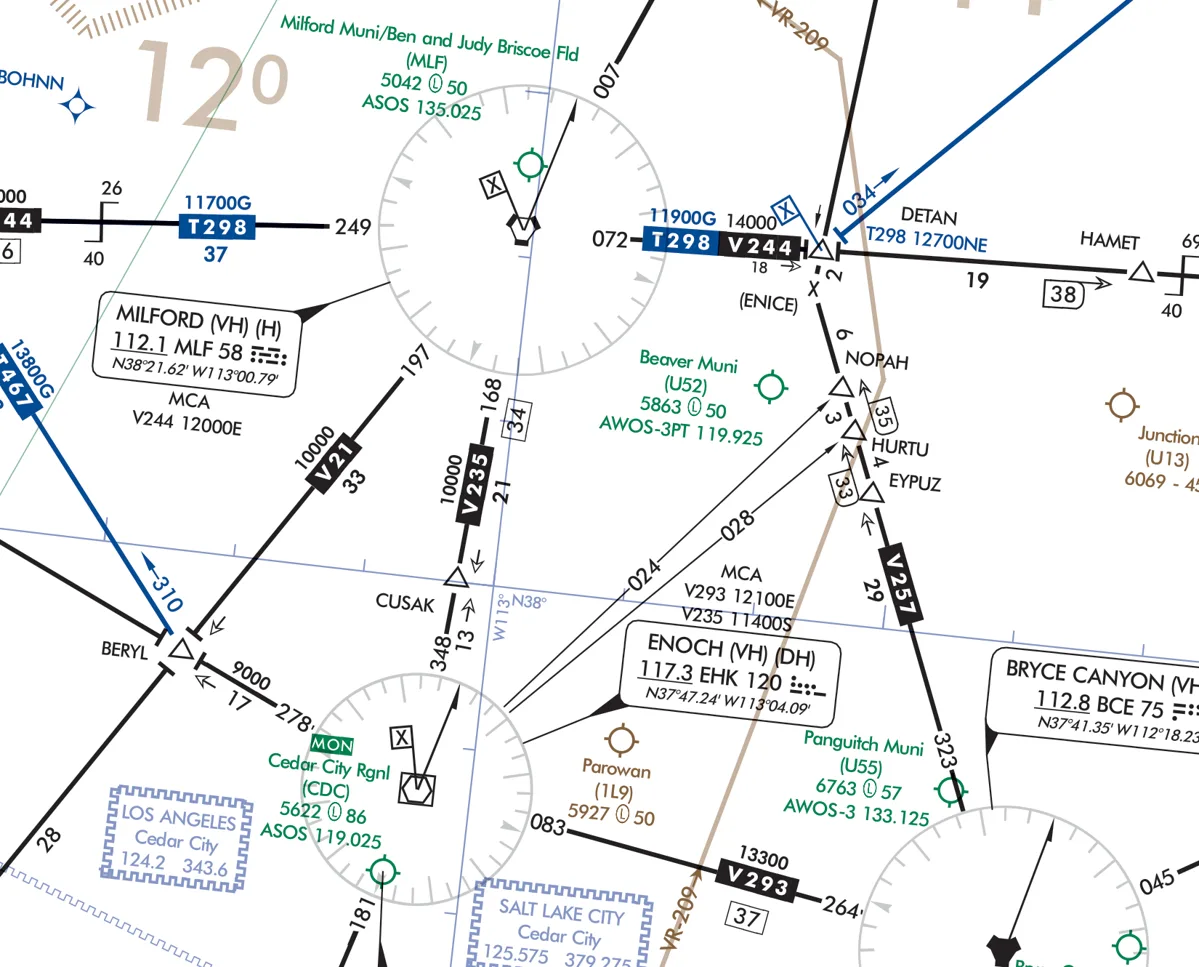
Example 1: climbing for an MCA and an expected altitude
Situation: departing Milford Municipal for Bryce Canyon, your clearance is "Cleared to Bryce Canyon airport via Milford, Victor two thirty-five Enoch, Victor two ninety-three Bryce Canyon. Climb and maintain one one thousand. Expect one five thousand at Enoch." Level at 11,000 between Milford and CUSAK, in cloud, the radio fails.
- Milford to Enoch on V235: the highest of 11,000 (assigned), 10,000 (MEA) and an expected altitude that doesn't apply until Enoch is 11,000.
- The MCA at Enoch: V293 has an eastbound MCA of 12,100 at Enoch, so you must cross Enoch at or above 12,100 (14 CFR 91.177(b)). The climb is 12,100 − 11,000 = 1,100 feet. At 500 feet per minute that takes 2.2 minutes, or 4.4 nautical miles at 2 a minute. Start climbing at least 4.4 nautical miles before Enoch.
- At Enoch, the expect fix: climb to 15,000, higher than the 13,300-foot MEA on V293. Without the expected altitude, you would climb to the 13,300-foot MEA instead.
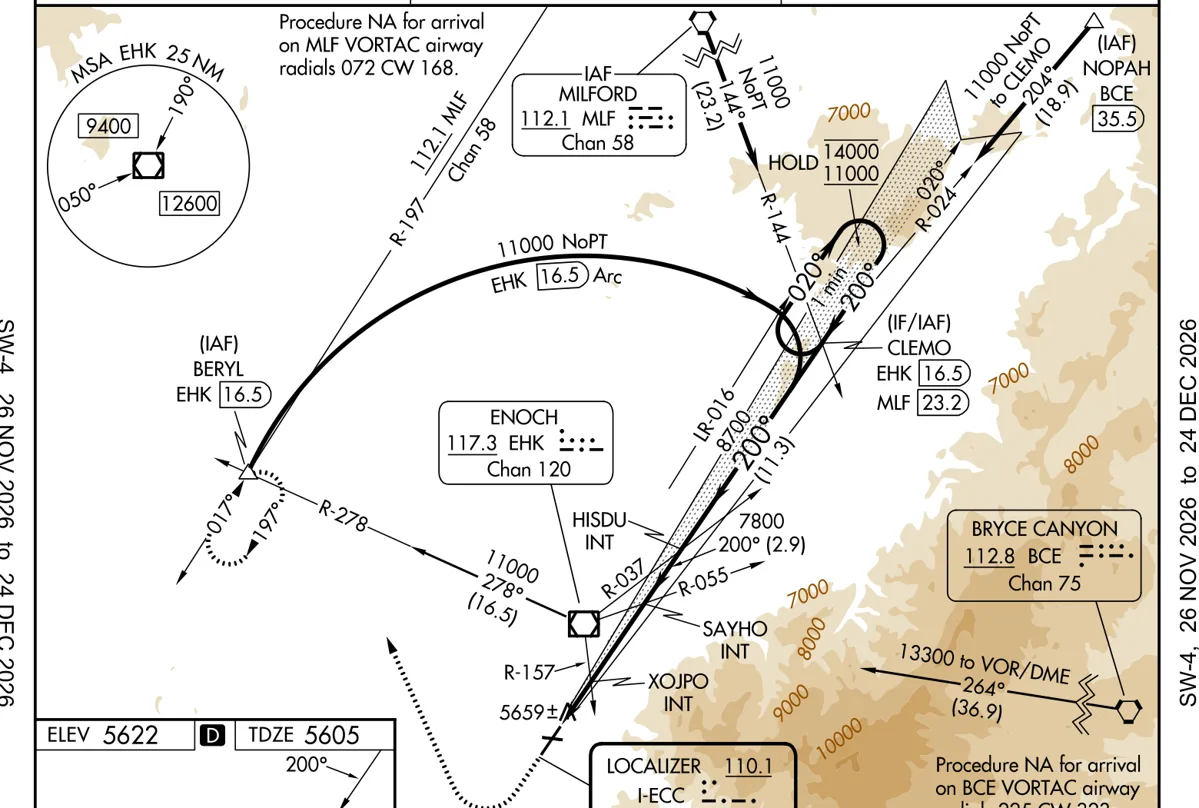
Example 2: an EFC at an IAF with a hold-in-lieu
Situation: inbound to Cedar City on the Milford 144 radial, you're told "Cleared to CLEMO, hold north, as published, maintain one one thousand, expect further clearance one four two zero." Your filed ETA is 1410. The radio fails at 1355 while you're holding in cloud.
- Altitude: 11,000 is your assigned altitude and the hold's minimum, so keep holding at 11,000.
- The clearance limit: CLEMO is an IAF of the ILS or LOC RWY 20, a fix where an approach begins.
- The time: you have an EFC, so start the descent and approach as close as possible to 1420. The 1410 ETA doesn't apply when you have an EFC (14 CFR 91.185(c)(3)(i)).
Example 3: a clearance limit that isn't an approach fix
Situation: southbound on V235 to Cedar City, ATC issues "Cleared to CUSAK, hold north on Victor two thirty-five, maintain one one thousand, expect further clearance one four five zero." Your filed ETA is 1435. You lose the radio while holding there in cloud.
CUSAK isn't a fix on any Cedar City approach chart. Enoch, 13 nautical miles south on V235, is the IAF of the VOR RWY 20.
With the EFC:
- Leave CUSAK at 1450 and fly V235 to Enoch at 11,000, the highest of 11,000 (assigned) and 10,000 (MEA).
- Arrival at Enoch: 13 nautical miles at 2 a minute is 6.5 minutes, so about 1456:30.
- The approach: your ETA of 1435 has passed, so as close as possible to it means start the VOR RWY 20 when you reach Enoch.
Without an EFC: suppose instead that ATC had said "Cleared to CUSAK, no delay expected" (JO 7110.65 4-6-1), and the radio failed before you reached CUSAK.
- Leave CUSAK when you reach it, say at 1420.
- Arrival at Enoch: about 1426:30, 8½ minutes before your ETA.
- The approach: hold at Enoch and start the approach as close as possible to 1435 (14 CFR 91.185(c)(3)(ii); FAA letter to Olshock, 2010). Enoch has no charted hold. The AIM's pattern for a fix reached without holding instructions is a standard pattern on the inbound course, here V235 (above, AIM 5-3-8c).
The 11,400-foot MCA for V235 southbound at Enoch applies only to a flight continuing south on V235 past Enoch.
On the checkride
Lost communications appears in the Airman Certification Standards (ACS) for the private pilot, commercial pilot, flight instructor, instrument rating and airline transport pilot (ATP) airplane tests.
| Test | ACS task | Elements |
|---|---|---|
| Private pilot (FAA-S-ACS-6C) | III.A, Communications, Light Signals, and Runway Lighting Systems | Lost communication procedures (PA.III.A.K5) |
| Commercial pilot (FAA-S-ACS-7B) | III.A, the same task | CA.III.A.K5 |
| Flight instructor (FAA-S-ACS-25) | VI.A, the same task, explained as an instructor | AI.VI.A.K5 |
| Instrument rating (FAA-S-ACS-8C) | VII.A, Loss of Communications; III.A, Compliance with Air Traffic Control Clearances | IR.VII.A.K1, S3, S4; IR.III.A.K2, K3 |
| ATP (FAA-S-ACS-11A) | VI.B, Departure Procedures; VI.C, Arrival Procedures | Communication failure procedures after takeoff and during an arrival (AA.VI.B.K4, AA.VI.C.K4, and S5 in each) |
On the private, commercial and flight instructor tests, the task also covers ATC light signals, transponder use and equipment issues that could cause a loss of communication (K3, K4, K6). This lesson covers the IFR rule, not light signals.
The instrument rating gives lost communications a task of its own. You need to know the procedures in each phase of flight, how to reestablish contact, when you may deviate from the clearance and when to begin the approach (IR.VII.A.K1). In the airplane, you decide whether to continue to the destination or deviate, and when to begin the approach (IR.VII.A.S3, S4). Area III, Task A adds your emergency authority and lost communications procedures (IR.III.A.K2, K3).
An instrument proficiency check (IPC) doesn't require either instrument rating task. The ACS lists the IPC tasks as a minimum (ACS, IPC table).
Try it: lost communications
All questions are under 14 CFR Part 91 with no other ATC authorization. Questions 5 to 8 use the lesson's charts around Cedar City, Utah, with a 500 feet per minute climb and a 120-knot ground speed. Clearances and times are invented. Decide before you check the answer.
Your radio fails in cloud on an IFR flight. Ten minutes later you break out into VFR conditions, 40 miles from your destination. What does 91.185 require?
Show the answer
Answer: B, Continue under VFR and land as soon as practicable. If you reach VFR conditions after the failure, 91.185(b) says to continue the flight under VFR and land as soon as practicable. The IFR route, altitude and clearance-limit rules in 91.185(c) apply when the failure occurs in IFR conditions, or when you can't comply with (b). "As soon as practicable" doesn't mean "as soon as possible": you don't have to land at an unauthorized or unsuitable airport, or one only minutes short of your destination.
- A. Once you're in VFR conditions, (b) applies: continue under VFR and land as soon as practicable.
- B. That's 91.185(b), and it applies once you reach VFR conditions after the failure.
- C. "As soon as practicable" isn't "as soon as possible." You needn't land at an unsuitable airport, or one just short of your destination.
Reference: 14 CFR 91.185(b); AIM 6-4-1c2, note
In IFR conditions, ATC says "Turn right heading two one zero, vector to Victor two thirty-five." A minute later, still on the heading, the radio fails. Which route do you fly?
Show the answer
Answer: A, Direct from where the radio failed to V235. If you're being radar vectored, 91.185(c)(1)(ii) sends you by the direct route from the point of radio failure to the fix, route or airway specified in the vector clearance, here V235. You don't keep flying the heading.
- A. Direct from the point of failure to the airway in the vector clearance is the second route on the list, and it applies while you're being vectored.
- B. The rule sends you direct from the point of failure to the airway in the vector clearance.
- C. The filed route is last on the list. While being vectored, you go direct to the fix, route or airway in the vector clearance.
Reference: 14 CFR 91.185(c)(1)(ii)
You filed via V23. Your clearance amended the route to V25. Your radio fails in IFR conditions, and you aren't being vectored. Which route do you fly?
Show the answer
Answer: C, V25, the route in your clearance. The first route on the list that applies is the route assigned in the last ATC clearance you received. The route ATC told you to expect comes next, and the filed route applies only when there's neither.
- A. 91.185 has no direct-to-destination option. The route in your last clearance comes first.
- B. The filed route is last on the list. Your clearance assigned V25.
- C. The route assigned in your last ATC clearance comes first.
Reference: 14 CFR 91.185(c)(1)
You're assigned 6,000 feet and told to expect 8,000 at fix b. The MEAs are 5,000 from a to c, 11,000 from c to d and 7,000 from d to e. The radio fails between a and b in IFR conditions. What altitude do you fly from d to e?
Show the answer
Answer: B, 8,000, the expected altitude. Fly the highest of the last assigned altitude, the minimum IFR altitude and the expected altitude, for each segment. From d to e those are 6,000, 7,000 and 8,000, so you descend from 11,000 to 8,000. This is the AIM's third example.
- A. The MEA is 7,000, but the expected altitude of 8,000 is higher.
- B. 8,000 is the highest of 6,000 assigned, the 7,000 MEA and 8,000 expected.
- C. 11,000 was the MEA from c to d. You pick the highest altitude for each segment, so you descend to 8,000 at d.
Reference: 14 CFR 91.185(c)(2); AIM 6-4-1c3(b), example 3
You're level at 11,000 on V235 toward Enoch when the radio fails in cloud. Your route continues east on V293, which has an MCA of 12,100 at Enoch. You climb at 500 feet per minute with a ground speed of 120 knots. How far before Enoch must you start climbing?
Show the answer
Answer: C, At least 4.4 nautical miles. You must cross Enoch at or above the 12,100-foot MCA. The climb is 12,100 − 11,000 = 1,100 feet, which takes 2.2 minutes at 500 feet per minute. At 120 knots (2 nautical miles a minute), that's 4.4 nautical miles.
- A. 2.2 is the time in minutes. At 2 nautical miles a minute, it's 4.4 nautical miles.
- B. That's twice the distance. 1,100 feet at 500 feet per minute is 2.2 minutes, or 4.4 nautical miles.
- C. 1,100 feet at 500 feet per minute is 2.2 minutes, or 4.4 nautical miles at 2 a minute.
Reference: 14 CFR 91.177(b); FAA L-9 chart
Your clearance was "Climb and maintain one one thousand. Expect one five thousand at Enoch." The radio failed before Enoch. Past Enoch, V293 has an MEA of 13,300. What altitude do you fly on V293?
Show the answer
Answer: A, 15,000. At Enoch, the expected altitude applies. On V293 the highest of 11,000 (assigned), 13,300 (MEA) and 15,000 (expected) is 15,000. Without the expected altitude you would climb to the 13,300-foot MEA.
- A. 15,000 is the highest of 11,000 assigned, the 13,300 MEA and 15,000 expected.
- B. The MEA is 13,300, but the expected altitude of 15,000 is higher and applies from Enoch.
- C. 12,100 is the MCA for crossing Enoch, not an altitude for the next segment.
Reference: 14 CFR 91.185(c)(2); AIM 6-4-1c3(b), note
You're holding at CLEMO, an IAF of the ILS or LOC RWY 20 at Cedar City. Your clearance gave an EFC of 1420, and your filed ETA is 1410. The radio fails at 1355 in cloud. When do you start the descent and approach?
Show the answer
Answer: C, As close as possible to 1420, your EFC. CLEMO is a fix where an approach begins. With an EFC, you start the descent, or the descent and approach, as close as possible to the EFC time. The ETA applies only without an EFC.
- A. The ETA is for a clearance limit with no EFC. You have one, so 1420 governs.
- B. At a fix where an approach begins, you start as close as possible to the EFC time, not right away.
- C. With an EFC at a fix where an approach begins, the EFC time governs.
Reference: 14 CFR 91.185(c)(3)(i)
You're holding at CUSAK, which isn't a fix on any Cedar City approach chart. Your EFC is 1450 and your filed ETA is 1435. Enoch, the IAF of the VOR RWY 20, is 13 nautical miles south. The radio fails in cloud. When do you leave CUSAK?
Show the answer
Answer: A, At 1450, the EFC time. At a clearance limit that isn't a fix where an approach begins, leave at the EFC time, fly to a fix where an approach begins, and start as close as possible to your ETA. Leaving at 1450, you reach Enoch at about 1456:30. The ETA has passed, so you start the VOR RWY 20 when you get there.
- A. At a fix that isn't an approach fix, you leave at the EFC time.
- B. The ETA tells you when to start the approach, not when to leave CUSAK. With an EFC, you leave at the EFC time.
- C. You'd leave on arrival only without an EFC. You have one, so you leave at 1450.
Reference: 14 CFR 91.185(c)(3)(ii)
Your clearance limit is the destination airport, and you have no EFC. After a radio failure in IFR conditions, you reach a fix where an approach begins 9 minutes before your ETA. According to the FAA's Chief Counsel, what do you do?
Show the answer
Answer: B, Hold at the approach fix and start the approach as close as possible to your ETA. The airport isn't a fix where an approach begins, so 91.185(c)(3)(ii) applies: proceed to the airport, then to a fix where an approach begins, and start as close as possible to your ETA. The Chief Counsel's letter to Olshock (2010) says to hold at the approach fix if you arrive early, and a 2018 letter reaffirmed it. Your emergency authority under 91.3(b) still applies.
- A. The Chief Counsel reads the rule as holding at the approach fix until you can start as close as possible to the ETA.
- B. That's the Chief Counsel's reading in the 2010 letter to Olshock, reaffirmed in 2018.
- C. The rule has you proceed to a fix where an approach begins. The hold, if you're early, is at that fix.
Reference: 14 CFR 91.185(c)(3)(ii); FAA Chief Counsel, letter to Olshock (2010)
After setting 7600, you try to reestablish contact. In what order does the AIM say to try the previously assigned frequency, a flight service station and 121.5 MHz?
Show the answer
Answer: C, It doesn't rank them, and says to try them all at once if you can. AIM 6-4-3 lists the previously assigned frequency, a flight service station, New York or San Francisco Radio, and 121.5 MHz without ranking them, and says to try them all at once if you can. These steps are AIM guidance. 14 CFR 91.185 doesn't include them.
- A. The AIM gives no order, and suggests trying them all at once if you can.
- B. The AIM doesn't put 121.5 first. It lists the options without ranking them.
- C. AIM 6-4-3 lists them without ranking and says to try them all at once if you can.
Reference: AIM 6-4-3
Source: 14 CFR 91.185 and 91.177 (eCFR); AIM 6-4-1 and 6-4-3 (Change 3, July 2026); FAA Chief Counsel, letter to Olshock (2010); FAA L-9 chart (29 October 2026) and d-TPP cycle 2612.
Next step
Sources and review
- 14 CFR 91.185, IFR operations: Two-way radio communications failure (eCFR)
- 14 CFR 91.177, Minimum altitudes for IFR operations (eCFR)
- 14 CFR 91.155, Basic VFR weather minimums (eCFR)
- 14 CFR 91.3, Responsibility and authority of the pilot in command (eCFR)
- AIM 6-4-1, Two-way Radio Communications Failure; 6-4-2, Transponder Operation During Two-way Communications Failure; and 6-4-3, Reestablishing Radio Contact (Change 3, effective 9 July 2026)
- AIM 4-4-3, Clearance Items (Change 3, effective 9 July 2026)
- AIM 5-3-8, Holding (Change 3, effective 9 July 2026)
- Pilot/Controller Glossary: Clearance Limit, Estimated Time En Route, Expect Further Clearance (Time), Initial Approach Fix, Lost Communications, Minimum Crossing Altitude, Minimum En Route IFR Altitude, Minimum Obstruction Clearance Altitude, Off-Route Obstruction Clearance Altitude, Vector, VFR Conditions (Change 3, effective 9 July 2026)
- FAA Order JO 7110.65BB, Air Traffic Control: 4-3-2, Departure Clearances; 4-6-1, Clearance to Holding Fix; 5-6-2, Methods; and 10-4-4, Communications Failure (Change 3, effective 9 July 2026)
- FAA Chief Counsel, letter to Olshock (16 March 2010): arriving early at a destination clearance limit
- FAA Chief Counsel, letter to Van West (16 January 2018): 91.185(c)(3)(ii) reaffirmed
- Instrument Procedures Handbook (FAA-H-8083-16B), chapter 1, radar SIDs, and chapter 4, terminal arrival areas and radar approaches
- U.S. AIP, GEN 1.7, Differences from ICAO Standards, Annex 2 3.6.5.2.2 and PANS-ATM 15.3
- Instrument Rating – Airplane ACS (FAA-S-ACS-8C), Area of Operation III, Task A, and Area of Operation VII, Task A
- Private Pilot – Airplane ACS (FAA-S-ACS-6C), Area of Operation III, Task A
- Commercial Pilot – Airplane ACS (FAA-S-ACS-7B), Area of Operation III, Task A
- Flight Instructor – Airplane ACS (FAA-S-ACS-25), Area of Operation VI, Task A
- Airline Transport Pilot and Type Rating – Airplane ACS (FAA-S-ACS-11A), Area of Operation VI, Tasks B and C
- FAA IFR en route low altitude chart L-9 (29 October 2026)
- FAA d-TPP, cycle 2612 (26 November to 24 December 2026): Cedar City (CDC) ILS or LOC RWY 20, Amdt 5, and VOR RWY 20, Amdt 8
Spotted a mistake? Report a correction.
Last Updated:
This post may contain affiliate links or advertisements. This means I earn a small commission if you decide to make a purchase through the links at no extra cost to you.